
Polygon plans to spend $50 million to $100 million over the next one to two years acquiring licensed companies in markets where it wants to offer payment services, co-founder Sandeep Nailwal said in a Moneycontrol interview cited by TechFlow on November 18, 2026. The plan covers North America, the European Union, Latin America and Southeast Asia. These are proposed acquisitions, not licenses Polygon has already obtained.
For a cross-border payment, the licensing strategy concerns the points where a sender’s local currency enters the system and where a recipient receives local currency. The reported plan identifies Brazil, Mexico and Southeast Asia as priorities for remittances and fiat on- and off-ramps. North America and the EU would support access for multinational companies and corporate treasury customers. Nailwal said Polygon’s longer-term goal is a U.S. banking charter and a role providing settlement services to large multinational institutions.
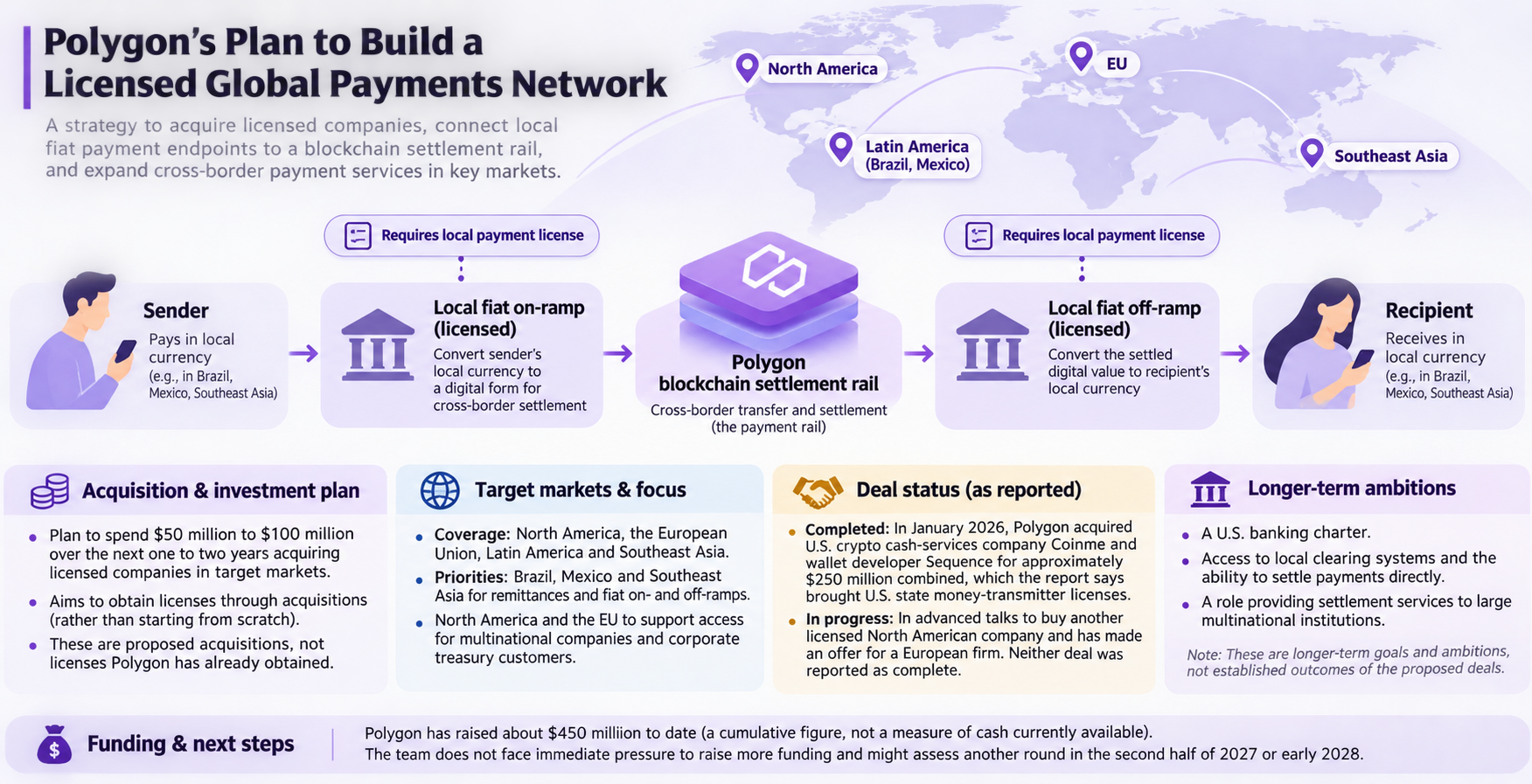
Polygon has already made an acquisition toward that strategy, according to the report: in January 2026, it bought U.S. crypto cash-services company Coinme and wallet developer Sequence for approximately $250 million combined. The report says the deal brought U.S. state money-transmitter licenses. Nailwal also said Polygon was in advanced talks to buy another licensed North American company and had made an offer for a European firm. Neither prospective deal was reported as complete.
A banking charter, access to local clearing systems and the ability to settle payments directly remain ambitions, not established outcomes of the proposed deals. The report says Polygon has raised about $450 million to date; that cumulative fundraising figure is not a measure of cash currently available. Nailwal said the team did not face immediate pressure to raise more funding and might assess another round in the second half of 2027 or early 2028.