
A crypto payment provider can have regulatory registrations, authorized partners and a working test transaction, yet still be unable to settle a customer’s payment. As the November 18, 2026 analysis describes, the question is not how many licenses a group holds. It is whether each step of the payment has an authorized operator, an acceptable account and a clear owner of the risk.
Consider the article’s hypothetical example: a business sends stablecoins to pay a European merchant, and the merchant is meant to receive euros in a bank account. To assess whether that payment can operate, the provider needs to trace three paths:
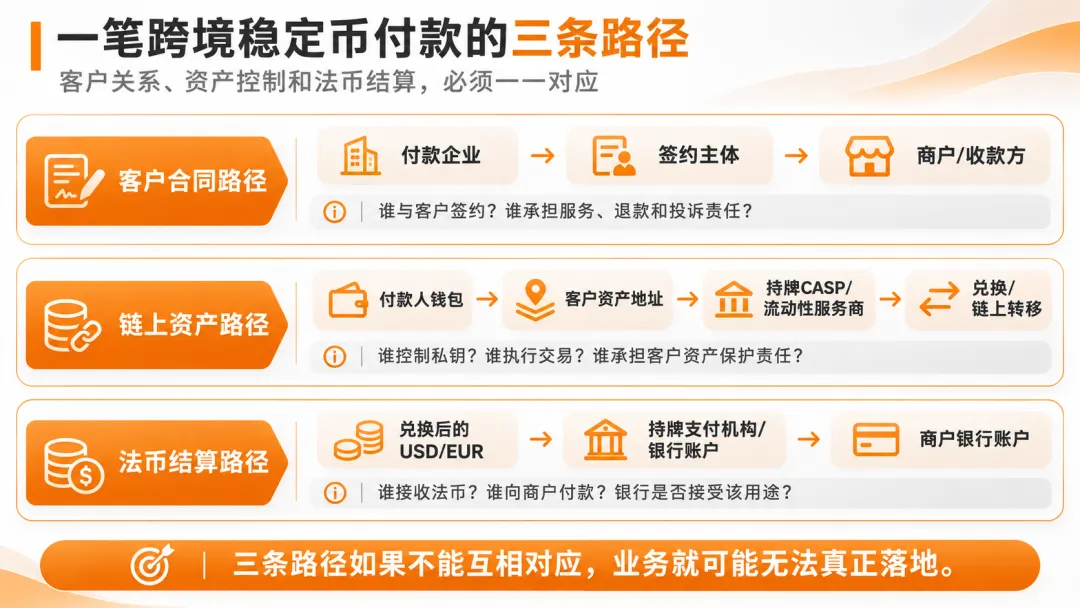
- The customer relationship: Which group company signs the customer agreement and handles complaints or refunds?
- Control of the stablecoins: Which address receives them, who controls the keys, when does control pass to a crypto-asset service provider or liquidity provider, and who can authorize a transaction?
- The fiat funds: Whose account receives the proceeds of conversion, is that account permitted to receive them, and who makes the final payment to the merchant?
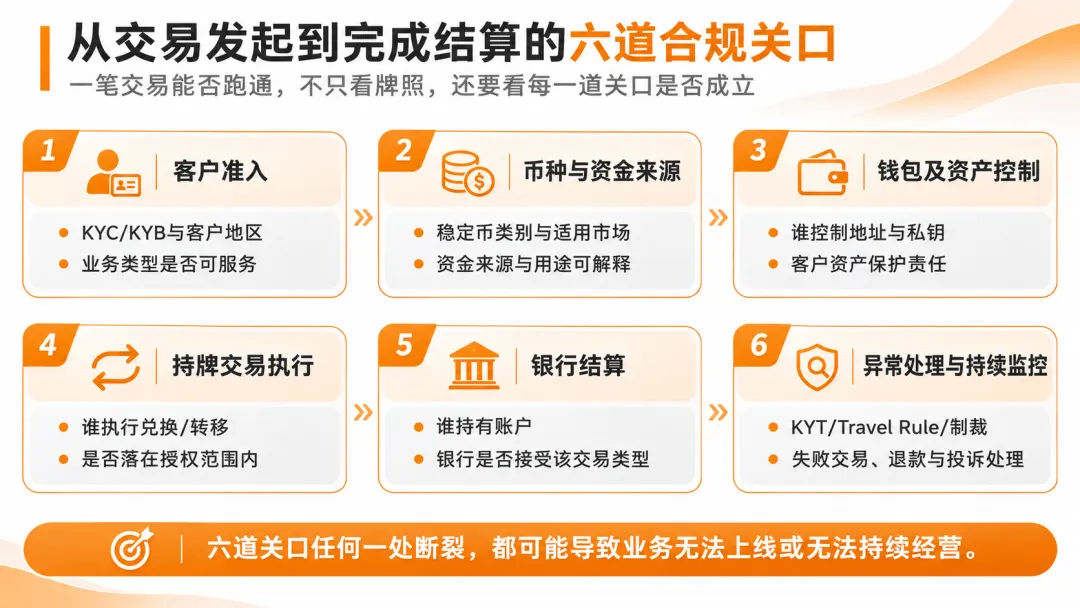
A mismatch between those paths can stop settlement. For example, a bank may allow a company to use an account for payroll and operating expenses but not to collect payments from multiple third-party customers. A payment partner’s banking arrangements may also have limits on customer locations, amounts, sources of funds or merchant categories.
Authorization has a defined scope
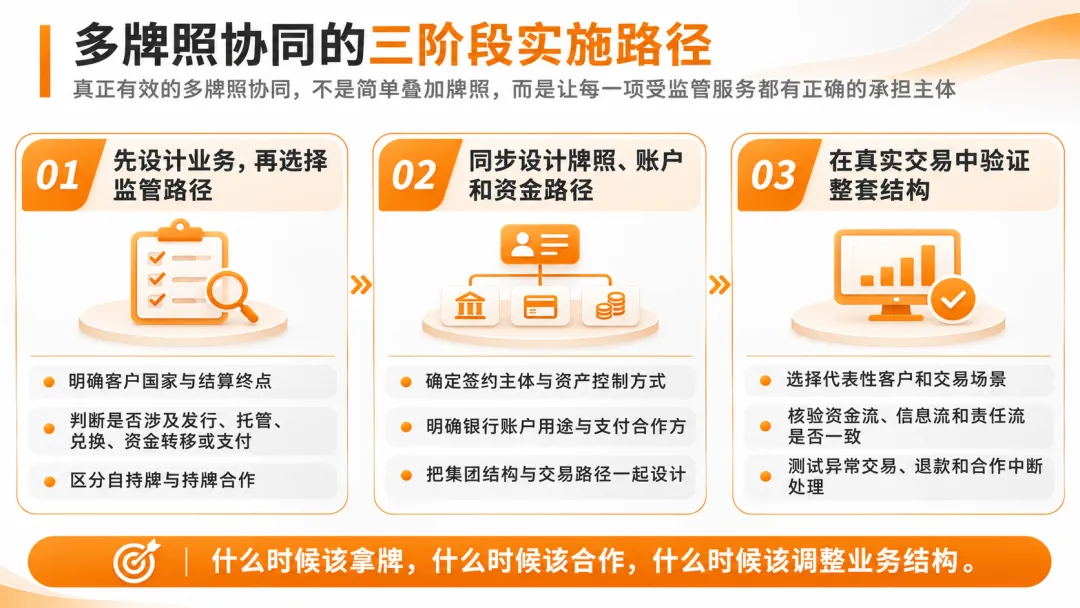
The article cautions against treating a group’s registrations as interchangeable. US FinCEN MSB registration is not a single nationwide authorization for all money-transmission activity; state-level requirements still need to be assessed. Under MiCA, an EU crypto-asset service provider can use passporting after the required cross-border notification, but only for services within its existing authorization. Passporting does not itself grant the full permissions of a payment or electronic-money institution.
For some services involving electronic-money tokens, the article also flags the end, on March 2, 2026, of an EBA transition period concerning the interaction between MiCA and PSD2. Providers may need to address payment-service authorization as well as crypto-asset authorization, depending on the activity.
Partners do not remove responsibility
Wallet technology, identity checks, conversion and fiat payouts can be supplied by different firms. That division can work, but their agreements and systems must establish who admits the customer, controls assets, monitors transactions, handles an alert or failed payment, shares data, and manages refunds and complaints. MiCA Article 73, as noted in the analysis, allows a CASP to outsource operational functions without transferring its regulatory responsibility.
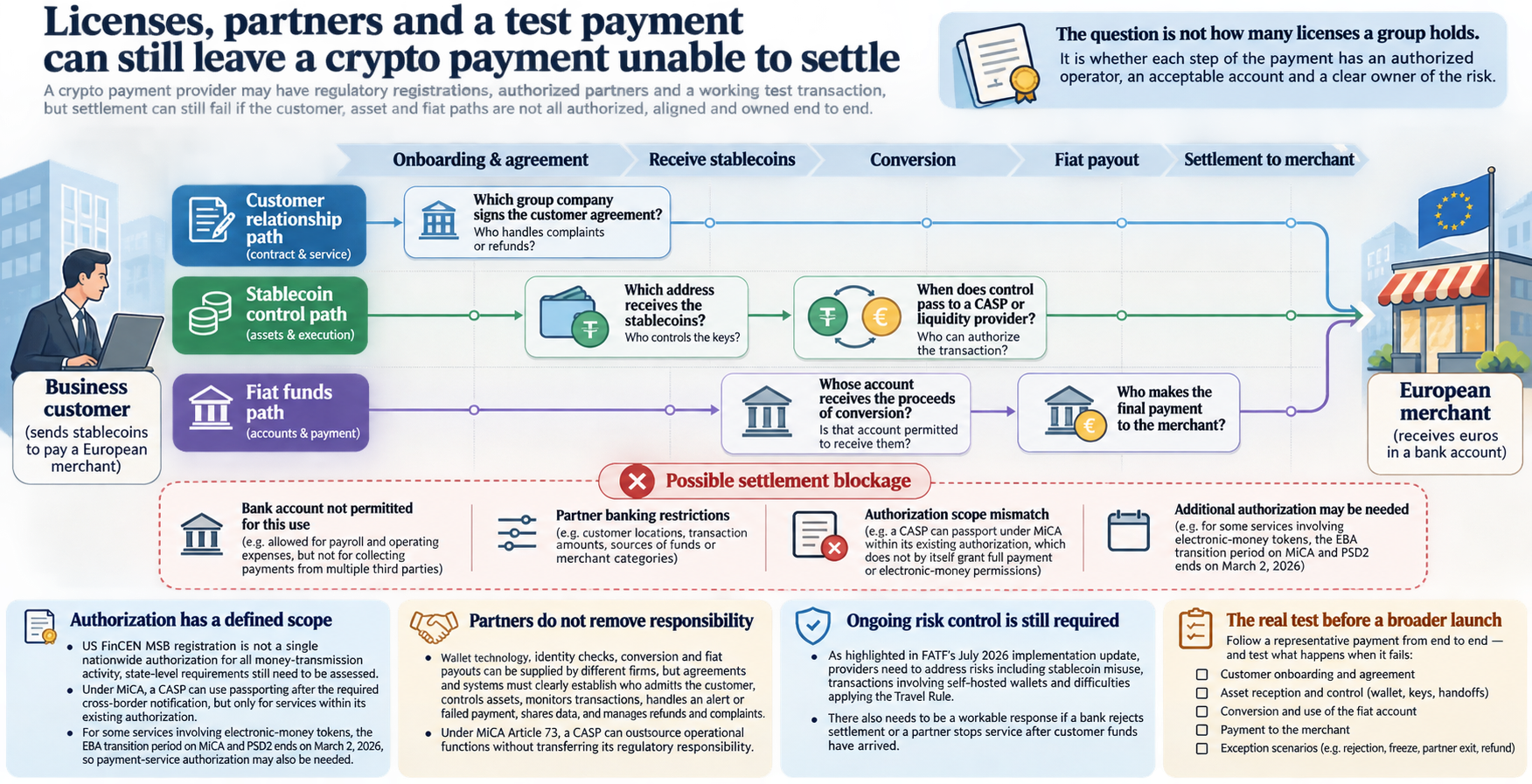
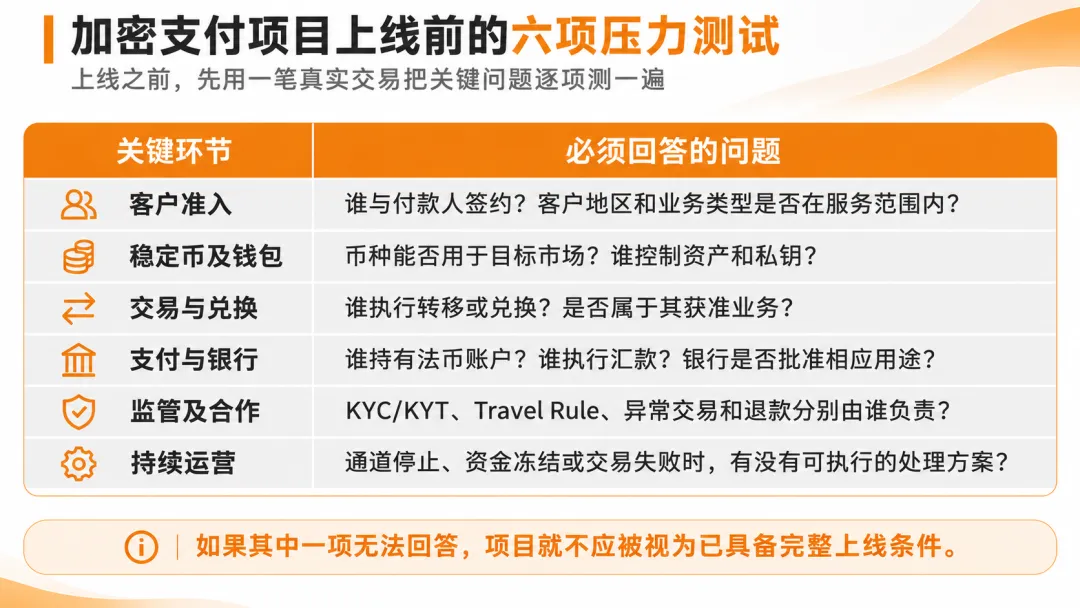
The need continues after a successful test payment. The article points to FATF’s July 2026 implementation update, which highlighted concerns including stablecoin misuse, transactions involving self-hosted wallets and difficulties applying the Travel Rule. A provider also needs a workable response if a bank rejects settlement or a partner stops service after customer funds have arrived.
The practical test before a broader launch is to follow a representative payment from customer onboarding through asset control, conversion and merchant receipt—and then test what happens when it fails. A license list cannot substitute for that account-by-account, party-by-party payment path.