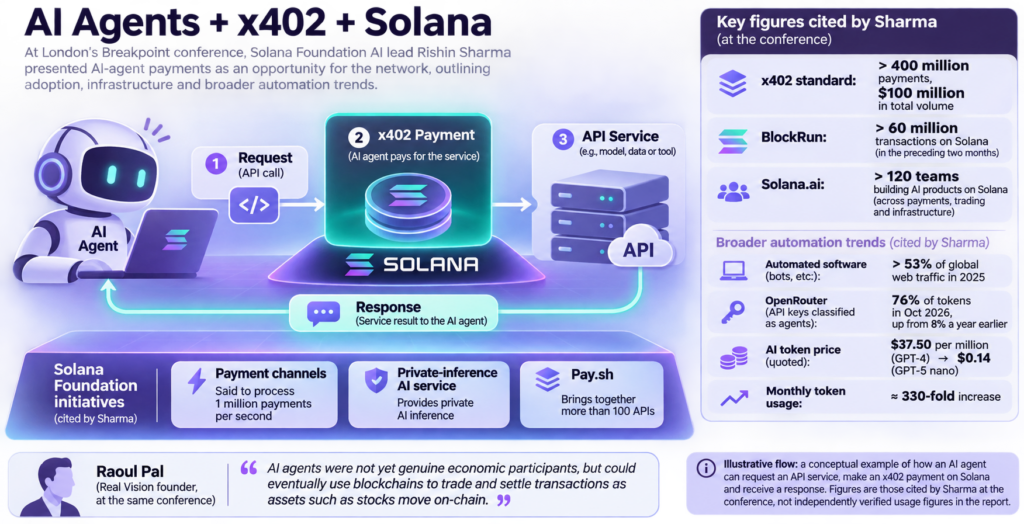
At London’s Breakpoint conference, Solana Foundation AI lead Rishin Sharma presented AI-agent payments as an opportunity for the network. As reported on November 17, 2026, he pointed to Solana.ai, a portal launched the previous week that listed more than 120 teams building AI products on Solana across payments, trading and infrastructure.
Sharma said the x402 standard, which lets AI agents make payments, had processed more than 400 million payments totaling $100 million. He also said BlockRun had processed more than 60 million transactions on Solana over the preceding two months. These are figures Sharma cited at the conference, not independently verified usage figures in the report.
The foundation has also introduced payment channels that it says can process 1 million payments per second, a private-inference AI service, and Pay.sh, which brings together more than 100 APIs. The report does not describe the payment channels’ funding, liquidity or settlement arrangements, so their claimed processing capacity should not be read as a measure of what any individual payment can send or receive.
Sharma cited broader signs of growing automation: bots and other automated software accounted for more than 53% of global web traffic in 2025, he said, while API keys classified as agents accounted for 76% of tokens processed by model marketplace OpenRouter in October 2026, up from 8% a year earlier. He also compared a quoted price of $37.50 per million tokens for GPT-4 with $0.14 for GPT-5 nano, and said monthly token usage had grown roughly 330-fold.
Earlier at the same conference, Real Vision founder Raoul Pal offered a longer-term view: AI agents were not yet genuine economic participants, he said, but could eventually use blockchains to trade and settle transactions as assets such as stocks move on-chain. That is a forecast, distinct from Sharma’s reported payment figures.