As reported on November 21, 2026, Tether had backed four companies over November 16–19 whose services could help move dollar-denominated value across borders. The investments span consumer accounts, payment infrastructure, a licensed payment institution and stablecoin liquidity. They do not, by themselves, mean USDT is available in every partner’s app.
Four investments, different parts of a payment route
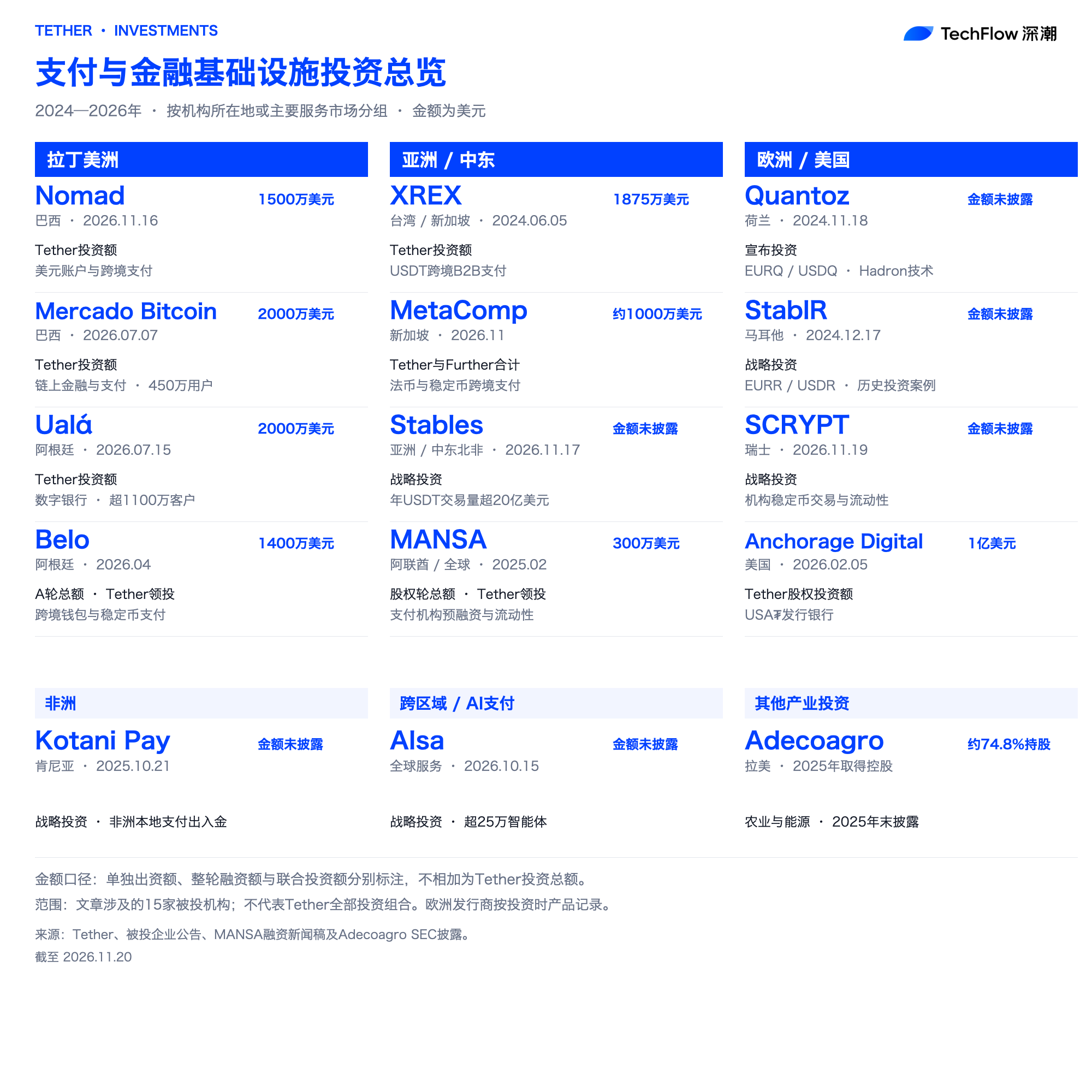
In Brazil, Tether Capital led a Series C round for dollar-account provider Nomad, investing $15 million. The round totaled 172 million Brazilian reais and valued Nomad at 4 billion reais after the investment. Nomad had 3.8 million customers and managed about 8 billion reais in assets. Integration of USDT and Tether’s gold token XAUT was still being explored, with no launch date announced.
Tether also invested in Stables, a payment-infrastructure company processing more than $2 billion in USDT transactions annually and focused on Asia and the Middle East and North Africa. In Singapore, Tether and Abu Dhabi-based Further Asset Management invested about $10 million combined in MetaComp, which holds a major payment institution licence from the Monetary Authority of Singapore. The funding was intended to expand its compliance and cross-border channels. The fourth investment was in SCRYPT, a Swiss stablecoin trading and liquidity provider that, according to the original report, has operated under FINMA and VQF oversight since 2019. The report did not give investment amounts for Stables or SCRYPT.
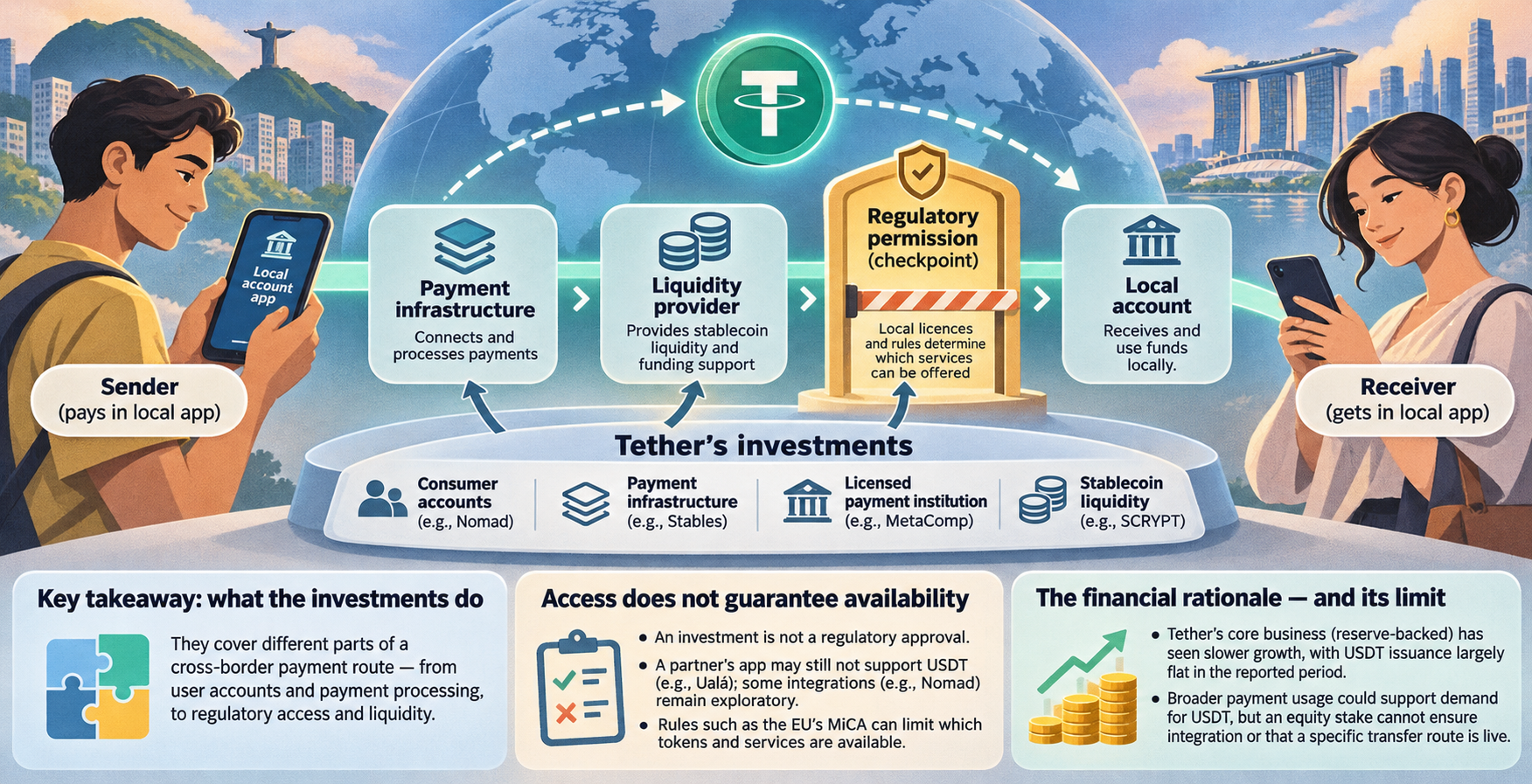
For a cross-border payment, access to a familiar account app is only one part of the journey. Payment providers also need a way to fund and settle transfers, while local permissions determine which services they can offer. Tether’s investments address different parts of that journey; they are not evidence that a particular transfer route is already live.
Why access does not guarantee availability
The distinction is clear in Tether’s earlier investment in Argentine digital bank Ualá. Despite Ualá’s more than 11 million customers, local regulatory limits meant USDT was not expected to be integrated in the short term. Nomad’s potential USDT integration likewise remained exploratory as of the November 21 report.
Regulation also shapes which token or partner can be used. The EU’s MiCA stablecoin provisions began applying on June 30, 2024, and MiCA became fully applicable on December 30, 2024. Without EU authorisation for USDT, licensed European exchanges began restricting or removing it. Tether instead invested in European third-party issuers, including Quantoz and StablR. In the United States, it invested $100 million in Anchorage Digital in February 2026; Anchorage issues the separately branded USA₮ stablecoin, launched on January 27, 2026.
Liquidity is another operational constraint. In February 2025, Tether led a $3 million pre-seed round for MANSA, which provides USDT pre-financing to payment companies so they need not hold as much money in advance across local markets. That describes a funding approach, not a guarantee that every payment will settle immediately.
The financial rationale—and its limit
The original report connected Tether’s search for payment channels to slower growth in its reserve-backed business. As of September 30, 2026, it reported $191.5 billion in reserve assets, including $132.4 billion in US Treasury exposure, and $4.5 billion in net operating profit for the first nine months. It described USDT issuance as largely flat at about $184 billion over that period. Its comparison with profit reported for 2024 used different profit measures, so the figures should not be treated as directly comparable.
More payment usage could support demand for USDT, but an equity stake cannot grant regulatory approval or ensure a token is integrated into an app. For senders and receivers, the practical question remains whether a permitted, funded payment route is actually available where each of them operates.