As reported on November 18, 2026, the World Bank Group said it would work with Circle and Citi to explore whether US dollar-linked stablecoin payments could move funds to borrowing countries faster and at lower cost. This is an exploration, not an announced rollout or a demonstrated saving.
Under the proposed arrangement, Circle would provide tools for issuing and transferring USDC, while Citi would connect the project to the banking networks the World Bank Group already uses for international payments. The group plans to start with borrowing countries that permit digital assets.
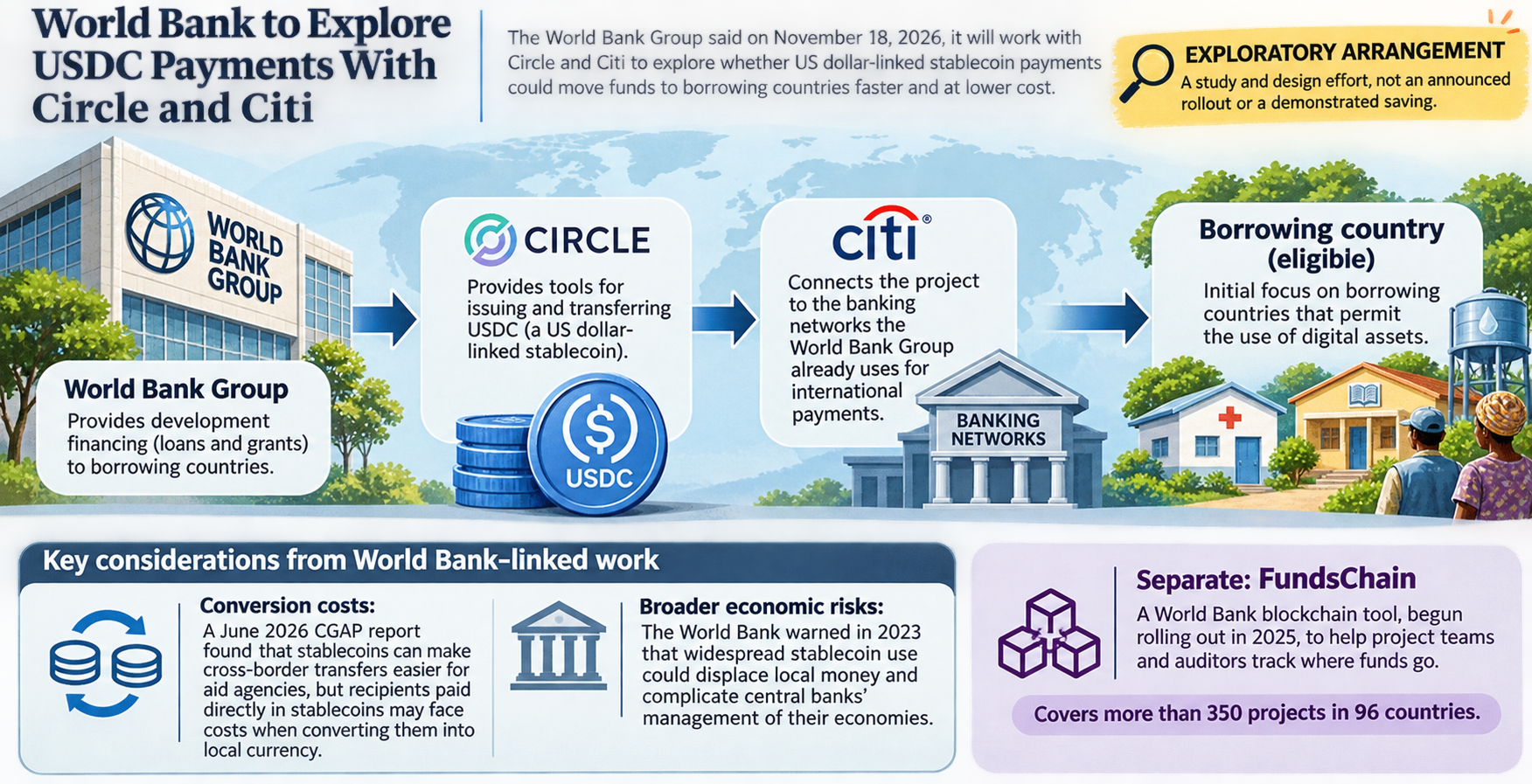
The payment question is what happens after funds are sent. A June 2026 report from CGAP, a research group based at the World Bank, found that stablecoins can make cross-border transfers easier for aid agencies, but recipients paid directly in stablecoins may face costs when converting them into local currency. The World Bank also warned in 2023 that widespread stablecoin use could displace local money and complicate central banks’ management of their economies.
This proposed payment work is separate from FundsChain, a blockchain tool the World Bank began rolling out in 2025 to help project teams and auditors track where funds go. The bank says FundsChain covers more than 350 projects in 96 countries.