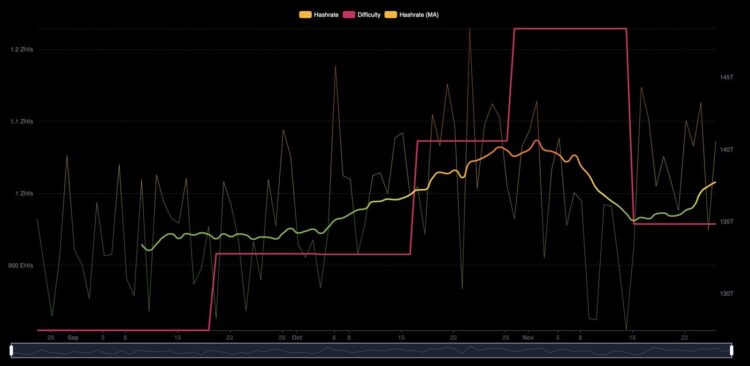
As of November 26, 2026, network estimates put Bitcoin’s next mining difficulty increase at about 9%. The adjustment, expected at block 977,760 on November 27, would take difficulty from 134.82 trillion to roughly 147 trillion, reversing much of the 9.13% reduction on November 14.
Bitcoin adjusts difficulty every 2,016 blocks to keep the average time between blocks near ten minutes. Blocks had been arriving faster than that target during the current period, pointing to an increase. The size of the change was not yet final.
What the same machines would earn
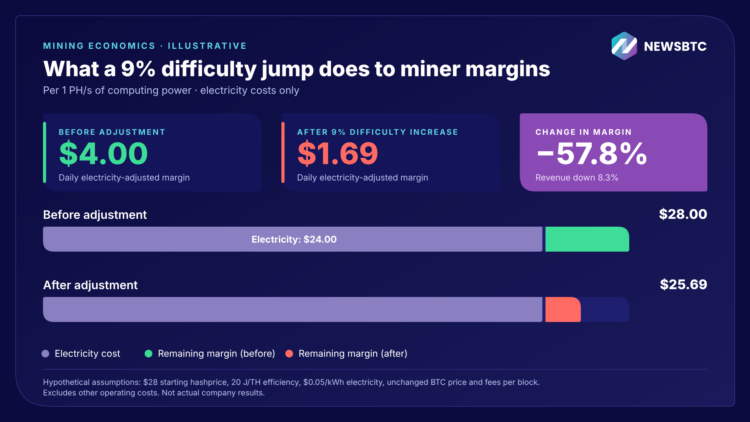
A 9% rise in difficulty would mean about 8.3% less BTC for the same computing power, all else equal. A fleet that could expect to earn 1 BTC over a given period before the adjustment would earn about 0.917 BTC over an equivalent period afterward, while using the same amount of electricity.
Mining industry trackers put hashprice—the expected daily revenue from a given amount of computing power—at about $28 per petahash. That figure reflects Bitcoin’s market price and transaction fees as well as mining difficulty.
Consider a fleet that uses 20 joules per terahash and pays $0.05 per kilowatt-hour. Running one petahash per second around the clock costs about $24 a day in electricity. At the reported hashprice, that leaves about $4 a day before hosting, cooling, maintenance and financing costs. If difficulty rose 9% while Bitcoin’s price and average fees per block held steady, daily revenue would fall to about $25.69. Less than $2 would remain after electricity costs alone.
A narrower margin is not evidence of Bitcoin sales
An operator with efficient machines and cheap power may be able to absorb the increase. For one running older equipment, it may make sense to switch off some machines. Some established miners are also redirecting data center infrastructure and power capacity toward artificial intelligence and high-performance computing, an option smaller operators may not have.
Power bills and debt repayments can put pressure on miners to sell BTC, but a difficulty increase does not show that sales have risen. Some miners hold reserves; others routinely sell their production. To assess whether selling has changed, miner balances, transfers to exchanges and company treasury disclosures offer better evidence than the difficulty estimate.