By the time Zhou reported on November 25, 2026, at 19:56:29 (UTC+8), two of the largest sellers of Bitcoin among public companies had put the proceeds to different uses. MARA used $750 million from a recent sale to repay Bitcoin-backed loans. Riot directed most of the roughly $1.5 billion it raised from Bitcoin sales in the first three quarters toward data center construction.
Both faced a mining business in which electricity alone consumed nearly all the revenue from some newer machines. But shifting power and sites to AI customers introduced a different problem: miners needed money to build facilities well before tenants would begin paying rent.
Mining revenue falls, but machines keep running
Bitcoin had fallen more than 20% in November, briefly approaching $55,000, its lowest level since September 2024. At an electricity price of $0.06 per kilowatt-hour, Antpool estimated that power consumed at least 97% of revenue for machines including the Antminer T21 and WhatsMiner M60S series. For the Avalon A1466I, mining revenue no longer covered electricity at that rate.
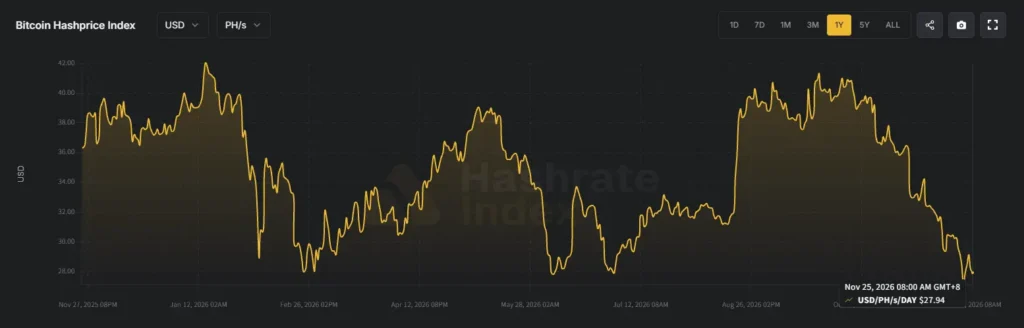
On November 25, Hashrate Index put daily mining revenue at $27.74 per petahash per second of computing power, near a one-year low. Yet the network’s seven-day average hashrate stood at 1,048.8 exahashes per second, with no sign of widespread shutdowns. Hashrate Index projected an increase of about 8.6% in mining difficulty on November 27; the adjustment had not yet taken place.
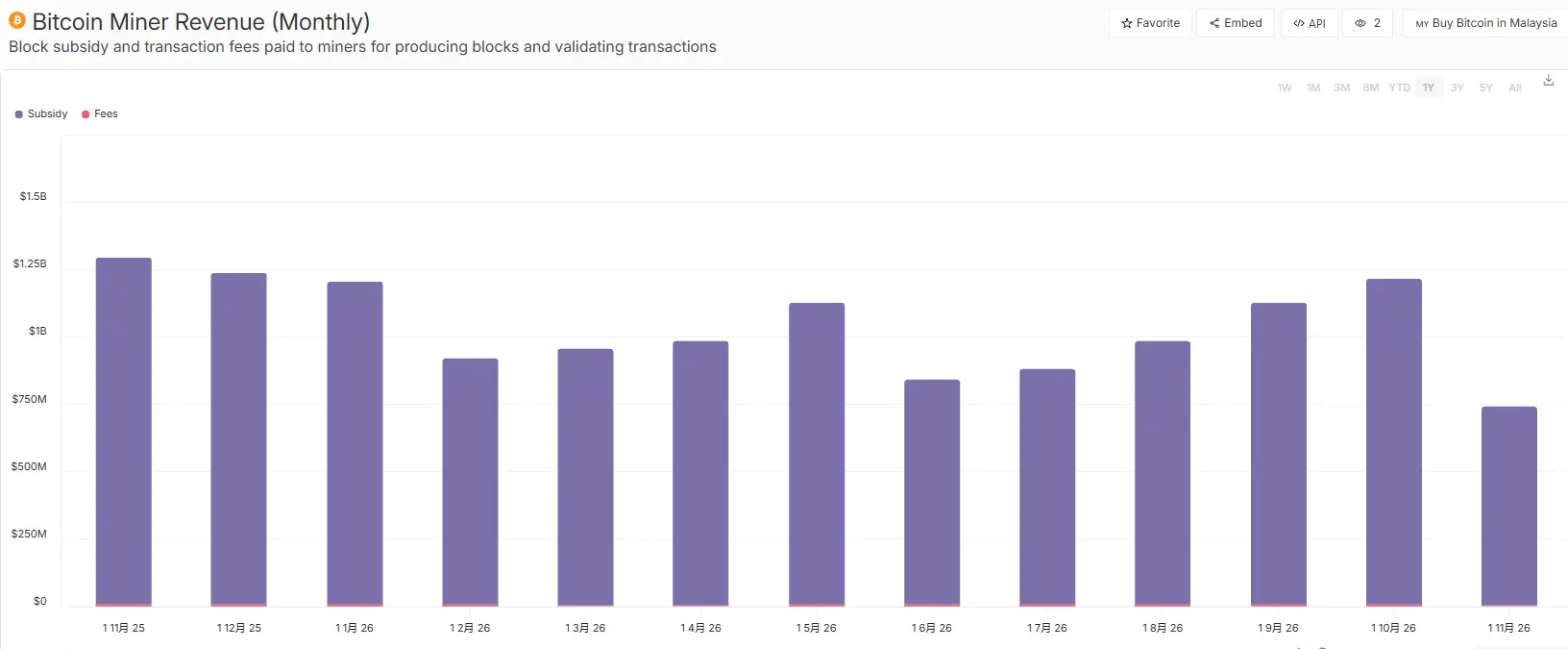
Newhedge recorded about $740 million in miner revenue for November to date, a pace well below October’s 11-month high of about $1.215 billion. Cost pressure predated the November decline: CoinShares estimated that public miners spent a weighted average of about $75,500 in cash to mine one bitcoin in the second quarter, compared with a quarter-end Bitcoin price of $58,400.
What the Bitcoin sales paid for
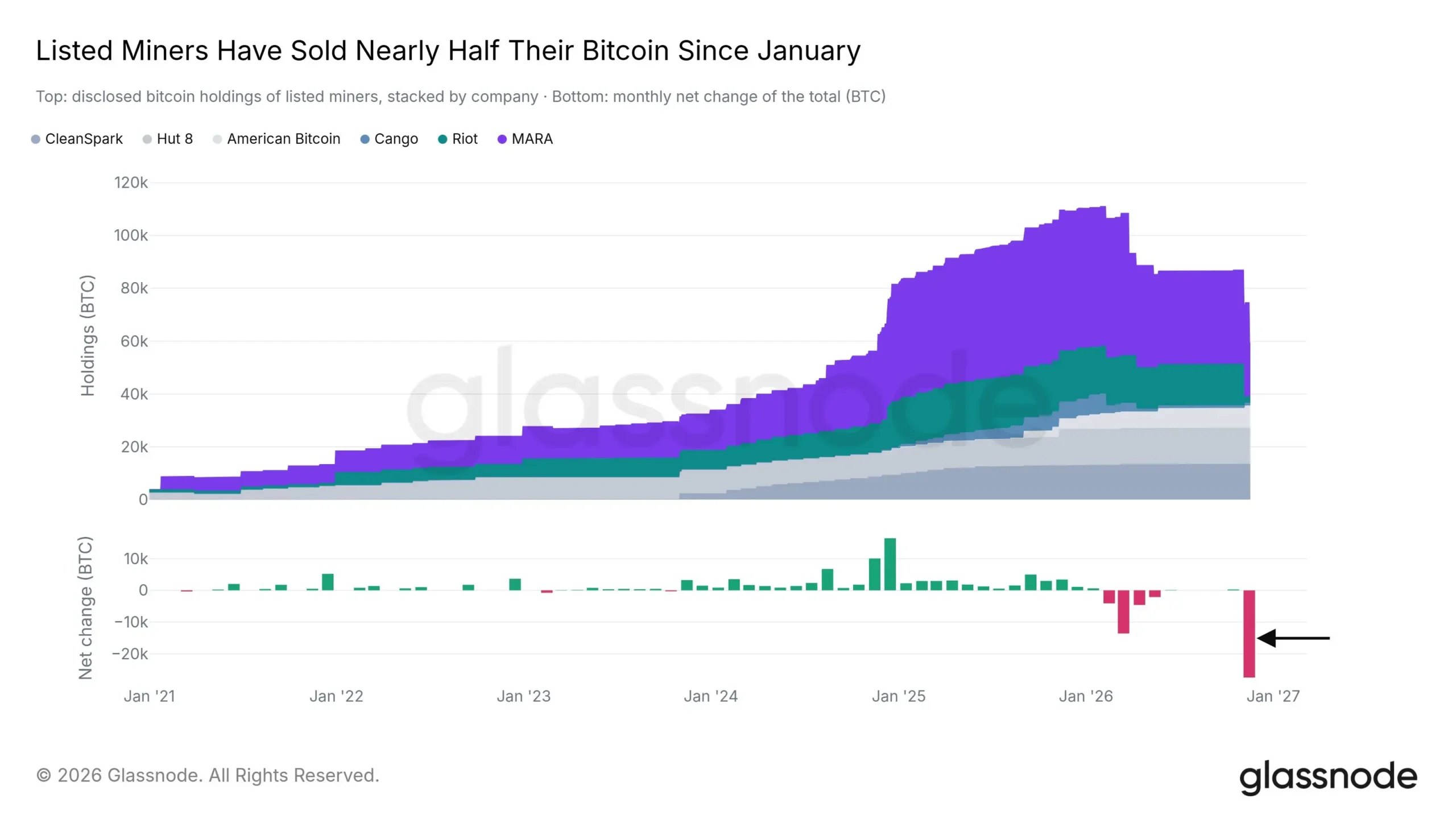
According to Lookonchain, 14 public companies, most of them miners, sold 108,247 BTC worth about $8.08 billion from the start of 2026 through November 10. MARA sold 40,581 BTC and Riot sold 20,264 BTC, together accounting for more than half the total. Glassnode said public miners had sold nearly half their reserves since January. Its chart showed a net decline of about 27,000 BTC in November to date, the largest monthly drop in its records.
MARA’s third-quarter shareholder letter detailed one of those sales: after the quarter ended, it sold 13,597 BTC at an average of about $81,039, raising roughly $1.1 billion. The $750 million loan repayment followed an earlier use of Bitcoin sales to repurchase convertible notes with about $1 billion in face value. Across the first three quarters, MARA cut debt by $1.4 billion, or 37%.
Riot, by contrast, reported funding data center construction primarily with its Bitcoin sale proceeds, without raising equity during the year to date. Its 10-Q identified Anthropic as the tenant for its entire Corsicana campus under a 15-year lease valued at about $28 billion. TeraWulf signed a 20-year lease with Anthropic worth about $19 billion. Most of the leases described in the report were not due to begin until the second half of 2027 or later, and several miners were counting on the same tenant for long-term revenue.
The funding gap before tenants start paying
CoinShares estimated that AI computing could generate about $1.5 million in annual profit per megawatt, compared with about $500,000 for Bitcoin mining. But it also estimated that converting a mining site for AI would cost $8 million to $15 million per megawatt, more than ten times the cost of building a mining facility. BlocksBridge Consulting counted $5.11 billion in first-half capital spending across nine public miners, against just $341 million in AI and high-performance computing revenue.
The financing risks depend on what each miner has agreed to supply:
- Riot expects to start arranging project financing for Corsicana in 2027. Management said lenders were examining tenant credit, power supply and delivery records more closely as interest rates and credit spreads rose. If Riot cannot obtain a loan on market terms, its tenant would advance about $3.6 billion for construction and recover it through deductions from rent at an implied annual rate of about 12%.
- Cipher, like Riot and TeraWulf, is pursuing long-term leases. It agreed to cover the first $359.3 million in costs above the original budget at its Barber Lake project.
- IREN buys its own GPUs to supply computing services to customers including Microsoft. It bears the risk that its equipment loses value and that a major customer changes its plans. About $6 billion of financing for its remaining fiscal 2027 capital spending was not yet secured. On November 5, IREN moved its target for exceeding $4 billion in annualized revenue from the end of 2026 to January 2027, possibly February, citing customer-requested design changes and supplier schedules. That same day, Bloomberg reported that Microsoft had tightened oversight of projects involving IREN, Nebius and Nscale and was discussing whether to sign more contracts with such providers.
- MARA had not signed a data center lease, according to its shareholder letter. Its only signed AI contract was a four-year, $79 million GPU services agreement at subsidiary Exaion. MARA continued to describe Bitcoin mining as its core business.
Share prices diverge before lease revenue arrives
November’s swings in AI stocks showed the limits of treating AI as a hedge against Bitcoin losses. Zhou reported that Nvidia CEO Jensen Huang resigned on November 12 and was reinstated by the board on November 23. From November 13 to 20, IREN fell 34.9% and MARA fell 27.2%, compared with a roughly 15% decline in Bitcoin. IREN rose more than 20% on the day of Huang’s reinstatement, then fell 11.54% the next day.
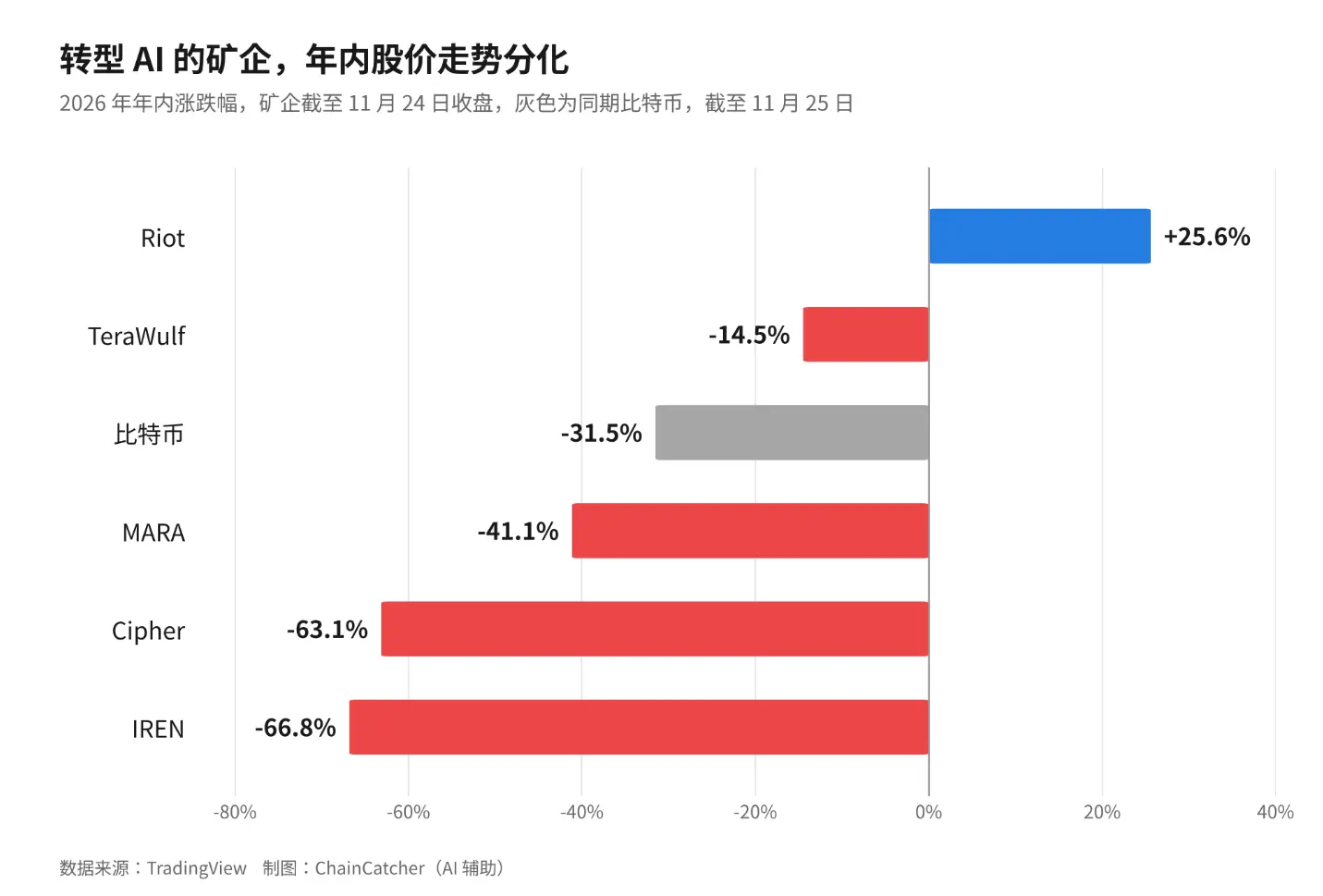
At the November 24 close, Riot was up 25.6% for the year, while IREN was down 66.8%, Cipher 63.1%, MARA 41.1% and TeraWulf 14.5%. The report’s text put Bitcoin’s year-to-date decline at 31.5% through that close; its accompanying chart instead labels the Bitcoin comparison as running through November 25, one day later than the miner returns.
None of the companies’ public disclosures indicated that a signed lease had been canceled. The immediate questions were how much financing miners could secure, at what cost, and whether they could deliver facilities on schedule.
For Bitcoin, the longer-term question is who supplies computing power as listed miners shift sites to AI. Hashrate Index estimated that the next halving would cut the block subsidy again around April 2028. In May, VanEck suggested that operators with access to underused, government-controlled hydropower and natural gas could take up some of the mining work. That remains a forecast: the November network figures did not show a large-scale shutdown or establish who might replace existing miners.