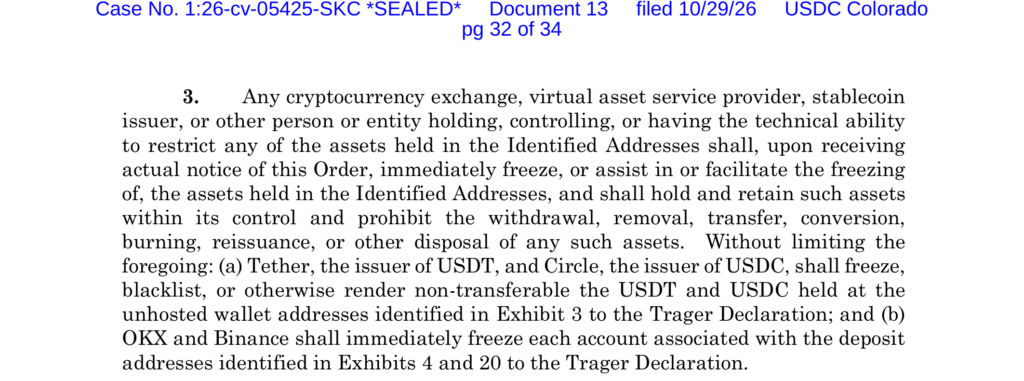
Reporting dated November 24, 2026 described a Colorado temporary restraining order that instructed Binance and OKX to freeze accounts linked to specified deposit addresses. Some holders who were not accused in the case said exchange balances they use as spendable funds were locked with them.
What the court told the exchanges to freeze
On October 29, a Colorado judge signed a temporary restraining order aimed at Huione Group and Xinbi, two Southeast Asian networks accused of laundering criminal proceeds. The US Treasury says Huione laundered at least $4 billion between 2021 and 2025. TRM Labs says Xinbi processed over $24 billion, mostly in USDT on TRON.
Plaintiffs served notice covering 27,304 TRON addresses. The order told Binance and OKX to freeze accounts linked to specified deposit addresses. Tracing on a public chain can follow transfers through many wallets, so the same address list can also reach funds held by people who are not accused in the case.
For a customer, that is not the same as a payment that fails to send. USDT may already be credited inside an exchange account. The court instruction stops the exchange from releasing it. While the case stayed sealed, Binance support could at first refer only to a “Sealed Case Name,” so users asking where the hold came from were not given the case name.
What users were told they could do
One trader on X claimed that roughly 400,000 USDT was locked. That amount is the trader’s claim. It is not a total confirmed by the court or the exchanges.
The November 24 report said affected users had until November 24 to contact the plaintiffs’ lawyers and raise objections. On November 23, Binance acknowledged that unrelated accounts could be affected and that the exchange could not independently release those funds. In a post that day, Binance said: “At Binance, protecting users and complying with applicable legal obligations are both core responsibilities. Our latest blog explains how court-ordered asset freezes work, why they may occur, what Binance can and cannot do, and what information may be available to affected users…”
The order was to stay in effect until November 27 unless extended.

Issuer blacklists and a later court freeze are different tools
The same night the Colorado judge signed the order, Binance was itself the victim of a major hack. That response did not wait for a court. Tether blacklisted 971 million USDT within 57 minutes. Within roughly 12 hours, issuers and protocols had frozen $2.84 billion, according to Recoveris, and that was before any court ruling. US prosecutors later secured approval to seize $1.2 billion.
Those steps are a different constraint from the Colorado order. An issuer blacklist can stop the stablecoin itself from moving. A court order to an exchange stops the platform from letting a customer withdraw or transfer a balance already credited on the books.
On November 18, Binance obtained a $6.5 billion worldwide freezing order from an Abu Dhabi court. It covered approximately 26,000 wallets, including parties Binance does not accuse of wrongdoing. Freezing powers can help recover stolen money. They can also reach wallets the applicant does not say were part of the wrongdoing.
An English court previously lifted a freezing order after the applicant failed to disclose that a wallet held pooled funds belonging to exchange customers.
Minutes to freeze, a court calendar to contest
During a BeInCrypto Market Intelligence Expert Council discussion, Erica Stanford, an adviser at law firm CMS, warned about wider power to restrict access to digital assets. “There’s definitely good use cases for freezing crypto assets… what you also don’t want is a new version of fiat money where at their will governments can freeze money, can seize money, can stop you having money.”
Patrick Prinz, co-founder of Recoveris, contrasted freezes by private companies with those by law enforcement. “I just wish there would be a clear seizing and freezing policy.”
Crypto transfers and freezes can cover billions of dollars within minutes. Deciding who may use the money again still follows court deadlines. Someone whose exchange balance was caught by the Colorado order can be left without funds they rely on for ordinary payments for days or weeks, even when they are not accused of a crime.