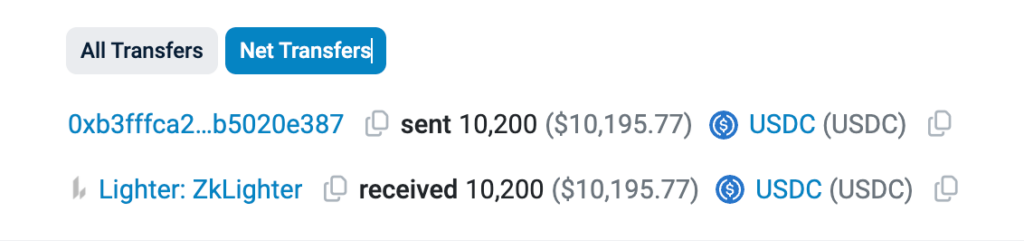
As reported on November 17, 2026, decentralized perpetual-futures platform Lighter said an attacker gained control of a trader account through an exposed API key and withdrew funds. Lighter attributed the exposure to insecure signing code in a nonofficial Lighter SDK: repeated use of a nonce allowed a private key to be recovered from public signature data. The company said its official SDK generated nonces securely and that its protocol, smart contracts and infrastructure were not compromised.
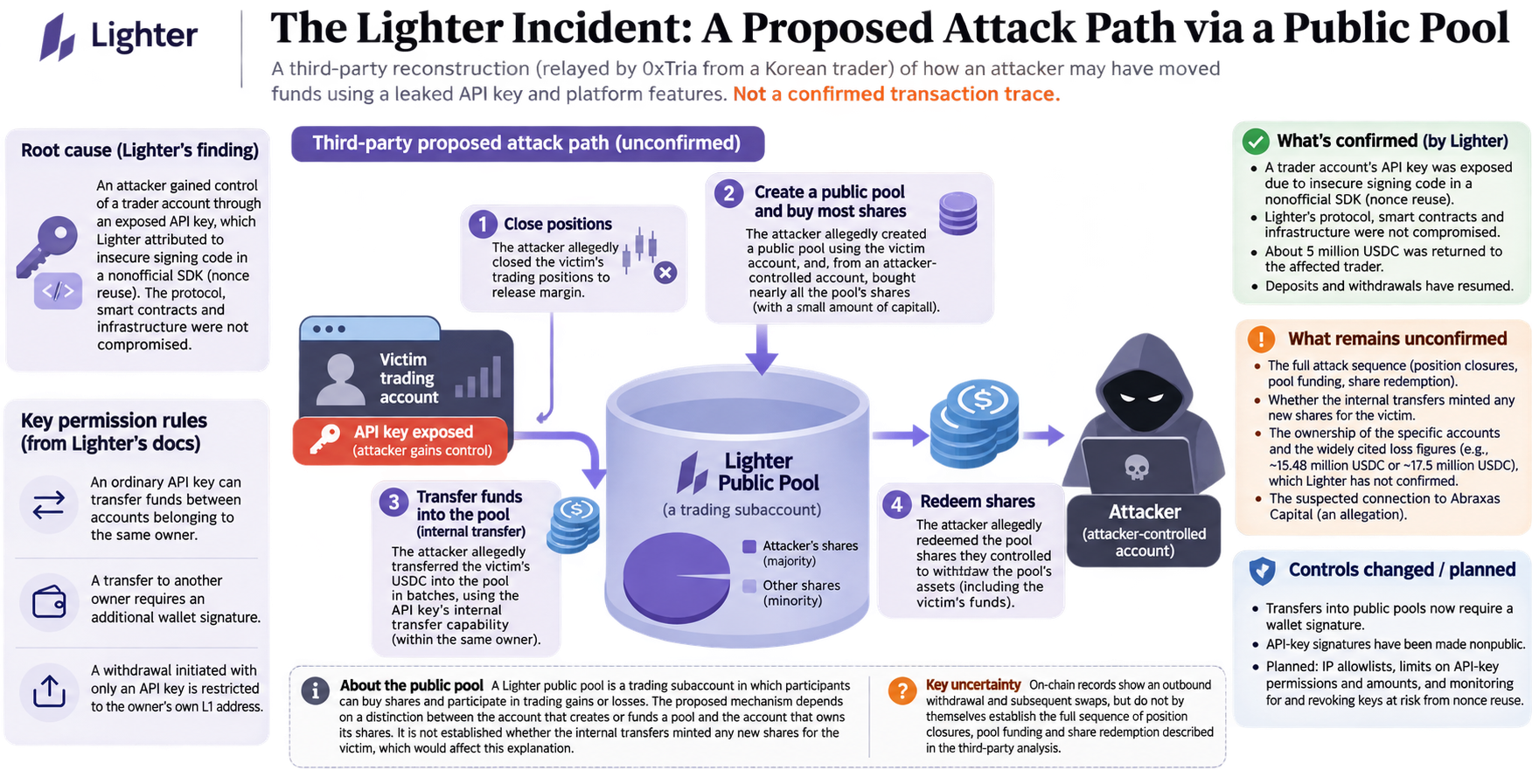
The remaining question is how the attacker could move value when an API key alone was not supposed to authorize a direct transfer to another owner. Lighter’s documentation says an ordinary API key can transfer funds between accounts belonging to the same owner; a transfer to another owner requires an additional wallet signature. A withdrawal initiated with only an API key is restricted to the owner’s own L1 address.

The proposed route through a public pool
According to an analysis relayed by arb.sh founder 0xTria from a Korean trader, the attacker may have closed positions in affected accounts, created a public pool using a victim account, and bought nearly all its shares with about $10,000 from an attacker-controlled account. The attacker allegedly transferred the victim’s USDC into that pool in batches of roughly $1 million, then redeemed the shares.
A Lighter public pool is a trading subaccount in which participants can buy shares and participate in trading gains or losses. The proposed mechanism depends on a distinction between the account that creates or funds a pool and the account that owns its shares. Whether the alleged internal transfers minted any new shares for the victim—which would affect that explanation—had not been established in the account of the incident. Lighter’s reported findings confirmed the key exposure, not every step of this third-party reconstruction.
0xTria’s initial account identified accounts #714710 and #714723 and estimated their affected funds at approximately 10.39 million and 5.09 million USDC, respectively, or 15.48 million USDC combined. 0xTria later cited roughly $17.5 million without details explaining the difference. Lighter had not confirmed the two accounts’ ownership or the 15.48 million USDC figure. 0xTria also suspected a connection to Abraxas Capital based on the origin of one account’s initial funding; that identification remained an allegation.
What the withdrawal record shows
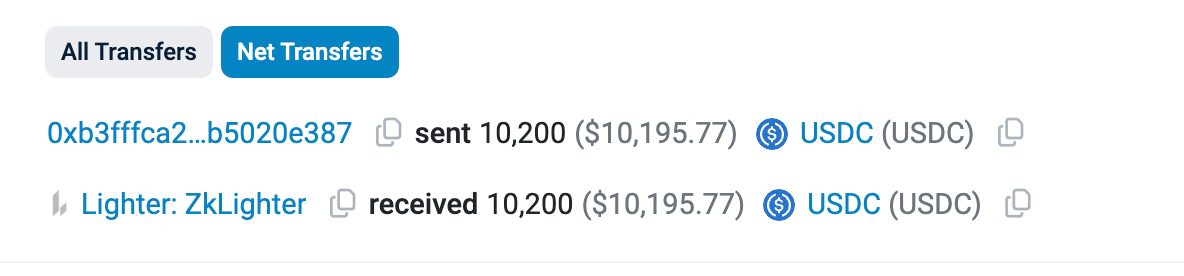
On-chain records cited in the November 17 report show an address depositing 10,200 USDC into Lighter account #769455 at 17:35:11 Beijing time on November 16. At 18:11:47, the address received approximately 10.3931 million USDC through Lighter’s pending-withdrawal claim function. Between 18:13 and 18:17, five CoW Protocol trades exchanged 10.36 million USDC for approximately 5,751.63 ETH/WETH. A later trade brought the six swaps’ combined total to 10,383,182.629682 USDC exchanged for about 5,764.470028 ETH/WETH.
Those records establish an outbound withdrawal and subsequent swaps, but do not by themselves establish the proposed sequence of position closures, pool funding and share redemption. Bubblemaps said some funds later reached Hyperliquid and were converted into XMR1, a wrapped Monero asset.
Controls changed; service restored
Lighter initially activated Guardian mode and suspended withdrawals while its security committee worked on a contract upgrade and recovery of funds involved in a further withdrawal attempt. In its November 17 update, Lighter said the committee had returned about 5 million USDC to the affected trader. Deposits and withdrawals had resumed, with pending withdrawal requests being processed.
Lighter also said transfers into public pools now require a wallet signature and API-key signatures have been made nonpublic. It plans IP allowlists and limits on API-key permissions and amounts, and said it would monitor for and revoke keys at risk from nonce reuse. Those planned controls should not be confused with the changes Lighter said it had already made.